




Home > How to Avoid Bad Credit
How to Avoid Bad Credit
CreditRepair.org’s Interview with Mint.com
 Though only five years old, Mint.com has quickly established itself as a highly recognized personal finance management web-service. For the uninitiated, Mint.com has been listed by Time Magazine as a top-50 website for the last three consecutive years and is the winner of the Webby Award for Excellence on the Internet for Best Financial Service in 2009, 2010, and 2011, beating out financial news giants CNNMoney, NY Times Dealbook, Nerdwallet and Yahoo! Finance.
Mint.com allows its users to aggregate their banking accounts, investments, insurance policies, IRAs and mortgages into its management system which automatically provides up-to-date categorization, support and tools for budgeting analysis and bill reminder services. Their services are essential for those wanting to take control of their financial lives and improve their credit scores. Best of all, Mint.com is completely free.
The site was conceived by Aaron Patzer in 2006 after quitting his day job as a software architect to develop a method for analyzing numerous financial documents with high accuracy. After gaining the interest of First Round Capital, Mint.com received the seed capital to further develop their concept. Patzer’s ideas ambitions became so popular that grabbed the attention of Intuit, a financial software company and maker of Quicken, which extended an offer to purchase Mint.com for $170 million in late 2009.
CreditRepair.org was granted an opportunity to gain some insight into the company from Aaron Forth, Inuit’s Vice President and General Manager of Personal Finance Group. Read more…
What Are The Stages of Late Credit Card Payments?
Late payments go through several stages. In the beginning, the consequences are mild, there’s very little impact to your credit. As you get become more delinquent on your payments, your credit is affected more, your balance grows and it’s harder to get caught up. Understanding the stages of a late payment may make you want to work harder to keep your payments on time.
Less than 30 days late
If you’ve only missed your due date by a few days, you’re still less than 30 days late. Your credit card issuer will charge a late fee (which may not show up until your next bill), but at this point, nothing goes on your credit report. Send your payment before your next due date and the credit bureaus will never know you were late.
30-89 days late
Once you’re 30 days late, however, the credit card issuer will update your credit report to show that your payment was late. If you catch up on your payments, your account status will go back to current, but the old late payment still remains. On the other hand, if you miss your payment again, making you 60 days late, your credit card issuer can charge the maximum late fee of $35. After that, your interest rate increases to the default rate.
90 to 180 days late
Between 90 and 180 days late, the late notices continue to be Read more…
Can Debit Cards Hurt Your Credit Score?
Since the credit crunch, more people have decided to use debit cards instead of credit cards for their purchases. On one hand, using debit cards can be smarter since the transactions come straight from your checking account – you don’t have to repay a credit card balance. But, there may be some drawbacks to using your debit card; your credit score could be affected.
What Affects Your Credit Score
Using a debit card in itself isn’t going to affect your credit score. Your checking account activity isn’t normally listed on your credit report. Even overdrafts don’t appear on your credit report unless the account gets closed and you never pay back the delinquent balance. Of course, that’s a stretch. You need your checking account so you’ll probably clear up any overdrafts quickly and your credit score won’t get hurt in that way.
What does happen when you choose your debit card for purchases is that your credit card gets neglected. After your credit card is inactive for several months, the credit scoring calculation ignores that account on your credit report. If this account has a good amount of available credit, your credit utilization could go up and your credit score will drop. Fortunately, all you have to do to reactive your credit card is use it. Once your account becomes active again, the credit scoring calculation will once again include that account in your credit score.
Credit card issuers don’t like inactive credit card accounts. In fact, your credit card issuer could close your account if it remains dormant for several months. A closed credit card would affect your account in the same way as an inactive account. The difference is Read more…
How to Keep Good Credit During a Bad Economy
 When the economy suffers a downtown, your credit, unfortunately, may suffer too. But this may be the worst possible time to have a bad credit score. If you find yourself back on the job market, you’ll often need to have good credit to land a job and keep paying your bills. In a recession or tough economy, take necessary precautions to keep your credit intact.
Build an emergency fund.
If you’re actively paying off debt by sending lump sum payments every month, you may want to scale back on those payments for a few months while you save up an emergency fund. An emergency fund can help keep you afloat for a few weeks or months if you suffer a pay cut or get laid off. But, if you’re really close to paying off your credit cards – like a couple of months – it’s okay to knock out those credit card bills. Then, once you’re done start up your emergency fund.
Call a credit counseling agency.
After suffering a job loss, you may not be able to afford your credit card payments. Get in touch with a credit counseling agency immediately. They can work with your creditors to lower your interest rate and minimum payment. Your credit card billing statement will have the number to a credit counseling agency. Otherwise, you can visit the National Foundation for Credit Counseling’s website, NFCC.org.
Get a forbearance or deferment on your loans.
When you can’t afford your loan payments, Read more…
Quick and Easy Ways to Wreck Your Credit Score
Failing to make your payments on time will lower your credit score, but that may be the only reason that appeals to common sense. Stranger ways to lose points abound.
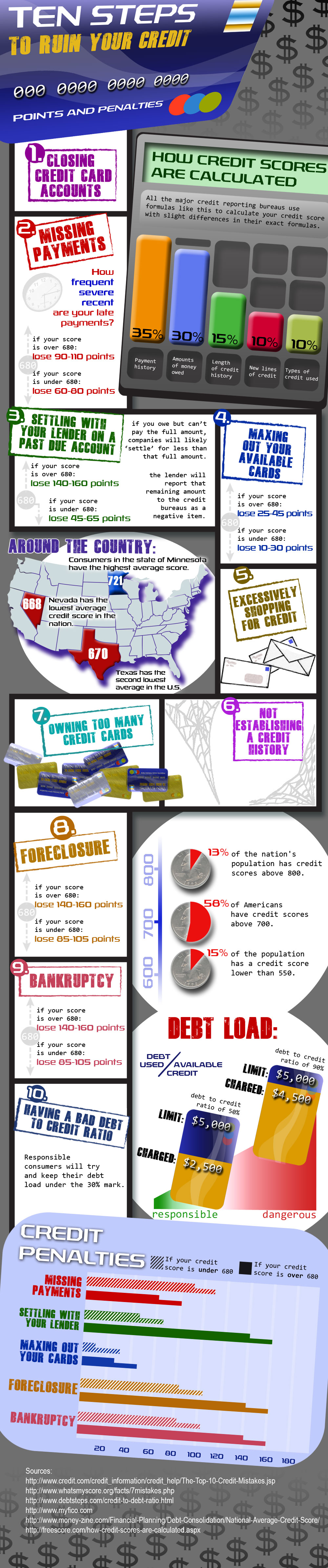 It takes years to build up a good credit score, but very little effort to trash it. In fact, sometimes it is the actions you take to manage your credit more responsibly that lower your score. Obviously, missing payments affects your score negatively, as it should.
If you have several cards and aren’t using them, you might naturally think that getting rid of available credit and loans would show how responsible you are, and get you a nod of approval from the credit police, wouldn’t you? Actually, the opposite is true. Closing card accounts lowers your available credit, so the ratio between any debt you have and the amount you can make use of becomes higher. This is known as your debt to credit ratio, or debt load.
Say you have three credit cards, each with a $1,000 credit limit. That means you have $3,000 available to you. If you charge $1,000 on one card, your debt load is now $1,000 from $3,000, or 33.3% So now you have a monthly payment, and realize that by the time you get it all paid off (depending on your interest rate), you are going to pay $1,400 for $1,000 worth of stuff you didn’t really have to have after all.
You’re thinking like a grown-up now. Proud of your new awareness, you cut up one of your other cards since you will never be so frivolous as to charge $3,000 worth of stuff. You call the bank and Read more…
Prepare Your Teens to Avoid Bad Credit
One of the reasons Americans have struggled so much with big debts and credit repair issues is due to the inexperience and lack of education concerning personal finances. In order for the youth of today to avoid credit nightmares tomorrow, they need to learn the basics from a young age.
Getting Help Early
Financial literacy is rarely taught in schools and for most young teens, financial responsibility lessons start at home. Parents of teens need to start educating their children about money management prior to sending them off to college. Waiting too long may mean it is too late to avoid bad credit and negative credit history marks. As teens graduate and move on to college, it is often the first time they are navigating life without mom and dad and are more prone to making credit mistakes.
What To Teach
Basic personal financial lessons can be incorporated into every day life. Starting with allowances and moving up to money management can give a child the foundation they need for staying ahead of the debt game many adults still struggle with later in life.
Here are a few of the basic credit and financial essentials kids need to learn early:
Save and Save More Often
Most Americans do not put enough cash into savings. They struggle to make ends meet and do not place a priority on savings. Teach kids to set aside a percentage of every dollar they receive or earn on their own.
Take Them to the Bank
Help a child to open a bank account to place Read more…
When Your Spouse’s Credit Affects Yours
 When two people get married, a lot of things combine, but credit histories and credit scores aren’t one of them. So, if you’re marrying someone who has bad credit, you don’t have to worry that their bad credit will drag yours down simply because you’ve been joined in holy matrimony. You do have to worry, however, if you’re applying for joint credit together, if your spouse has access to your accounts, or if your spouse has bad spending habits.
Applying for Joint Credit
Now that you’re married, there may be times when you apply for a credit card or loan with your spouse. For example, you may get a joint credit card if your spouse can’t qualify for one alone, to help your spouse repair their credit, or to make household accounting easier. Unfortunately, your spouse’s bad credit may keep you from qualifying for the best credit cards and you could wind up with a high interest rate, high fee credit card.
Applying for mortgages or car loans together will also prove difficult. Lenders have various ways of considering a joint applicant’s credit score. They may take an average of your scores or they may consider only the lowest credit score. Rarely, if ever, do they only count the highest credit score. This means you could qualify for a smaller loan, have a high down payment requirement, or have to pay a higher interest rate on the loan.
Adding a Spouse To Your Accounts
There’s a possibility that your spouse has bad credit because they have bad credit habits. If you add this spouse to your credit card accounts, their bad credit habits will Read more…
Dispelling a Credit Myth: Medical Bills Can Hurt Credit
When it comes to credit, what you don’t know can hurt you. Your financial profile can take a hit based on the information you do not clearly understand. The many myths of credit repair and credit scores can actually leave you in a worse situation than where you started.
The Reality of Medical Debts
One of these myths that is often believed by consumers is that medical bills do not hurt a credit score. Many times people will forgo paying off their medical bills to focus on their other creditor debts thinking that overdue medical bills won’t impact their credit score.
However, medical debts are treated just like any unpaid creditor debt. The money you owe is expected to be paid. The medical provider will not necessarily send the information to the credit reporting bureaus each month but they will pass your accounts to debt collectors. It is then that the unpaid debts will cause your credit score to drop and lenders will see your medical accounts are in bad condition.
Once an account goes into collections, regardless of the account type, you will not only have the drop in credit score, you will also have the Read more…
How to Deal With Collection Agencies on Your Credit Report
Clearing up your credit history often will involve handling collection agencies that have assumed your old debts. Collection agents are infamous for using tactics that are less-than-nice when trying to get back money owed. In many cases, a collection agent will get paid a percentage of the debt they are collecting on so they utilized no-holds-barred techniques to get a payment.
For some consumers who show collection agency information on their credit report, it can be difficult to negotiate the removal of the data from the report. But there are methods to be considered when trying to clear a collection agency debt from your consumer credit report.
Here are four options you have for handling a collection agency debt:
Pay Up In full
If the collection agency is able to validate your debt and it is a relatively small amount, it may be in your best interest to pay the balance off in full with the contingency that the debt information will be removed from your credit report. Not all collection agencies will be cooperative but many will agree to remove the data once the debt has been satisfied in full. They want to get back as much money as possible so they will be somewhat open to working with you. Too many consumers fail to ask for the incentive when they agree to pay in full so they end up with no real changes on their credit report. Get any agreements in writing.
Ask for a Settlement
For larger debts you can not afford to pay in full, discuss Read more…
What Should You Expect When You Have Bad Credit?
They say you never know a good thing until it’s gone and that includes a good credit score. When your credit score drops, your life could change. But, you can better manage the side-effects of a bad credit score when you know what to expect.
Trouble Renting
You might not know to expect it, but landlords check your credit report before they rent to you. Depending on what’s in your credit report, you may get turned down for an apartment. Or, if you’re approved, you may have to pay a higher security deposit to move in than if you have better credit.
It’s hard to tell which apartments do credit checks and which ones don’t. But, you can typically expect big apartment complexes to check credit. Condos and houses owned by individual landlords are less likely to do a credit check. Still, if you can stay put until your credit improves, you’ll have a better chance at getting approved.
Higher Security Deposits
If you do move somewhere else and you have to establish new utilities in your name, you may have to pay a higher security deposit. Utility companies like those that provide electricity, water, sewer, and cable, often run a credit check in the application process. Applicants with bad credit often have to pay an upfront deposit. Usually the deposit can be refunded or credited to your account after a certain number of timely payments, but be ready to pay the money upfront to get your services turned on. Read more…
Let's connect!